
This section presents findings from research undertaken by PAX on nuclear weapons investments held by three financial institutions: Lloyds Banking Group, NatWest Group (formerly RBS Group) and Standard Life Aberdeen.[1] The investments of other UK financial institutions are covered in section 7.
Lloyds Banking Group, which includes subsidiary Bank of Scotland, invested £3.4 billion in 10 of the nuclear weapons producers listed in section 2 between January 2018 and January 2020, while NatWest Group invested £2 billion in 15 companies. Most of these investments were made in the form of loans and the underwriting of bond issuances.
Standard Life Aberdeen owned shares worth over £1.5 billion in 20 nuclear weapons producers as of March 2020.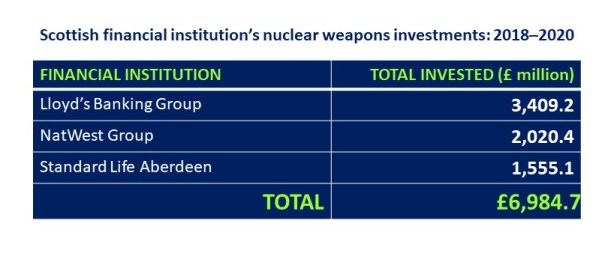 Irresponsible banking
Both Lloyds and NatWest Group are founding signatories to the UN Principles of Responsible Banking (UNPRB).[2] The UNPRB’s signature document states: “We believe that only in an inclusive society founded on human dignity, equality and the sustainable use of natural resources, can our clients and customers and, in turn, our businesses thrive.”[3]
This is a worthy sentiment that is undermined by the banks’ continued investment in nuclear weapons producers. The nuclear weapons industry is founded on human suffering, nuclear colonialism and environmental destruction.[4]
Uranium mining has contaminated Indigenous lands and poisoned precious water resources.[5] Nuclear testing destroyed whole islands and released harmful radioactive particles into the atmosphere, with far-reaching consequences.[6] Hazardous nuclear waste presents a grave risk to people and the environment for thousands of years.[7]
These activities have left a legacy of serious disease, such as cancer and leukaemia, among those exposed to radiation.[8] Indigenous people have been disproportionately harmed while women are more susceptible than men to the health impacts of ionising radiation, as the UN Treaty on the Prohibition of Nuclear Weapons (TPNW) acknowledges.
Furthermore, if nuclear weapons were ever used in war it is unlikely that anyone would thrive in the society that would be left to deal with the aftermath (see section 1.1). As the TPNW states, the catastrophic consequences of nuclear weapons “cannot be adequately addressed, transcend national borders, pose grave implications for human survival, the environment, socioeconomic development, the global economy, food security and the health of current and future generations”.
Both NatWest Group and Lloyds Banking Group state that they will not finance companies that are involved in the production of cluster munitions or landmines – weapons which are banned by international treaty.[9] The entry into force of the TPNW in January 2021 puts nuclear weapons into the same category.
The only responsible course of action for these banks is to stop financing nuclear weapons producers too.
Action
If you are a customer of a financial institutions that invests in nuclear weapons, please tell them why you think they should adopt a comprehensive exclusion policy. Template emails are available here: https://investinginchange.uk/action/
NOTES
[1] See the forthcoming report by S Snyder, Problematic Profiteering: Private company involvement in nuclear weapon production and their financial backers (PAX, 2021) which will be published at https://www.dontbankonthebomb.com/. The figures in this section differ from the figures used in the global report published by PAX because the latter uses a reporting threshold: only share and bond holdings larger than 0.5% of the total outstanding shares or bonds of the nuclear weapon producing companies are listed. However, we have included all of the investments in PAX’s research in order to give a fuller picture of Scotland’s investments in the nuclear weapons industry. Questions about PAX’s research can be sent to info@dontbankonthebomb.com.
[2] NatWest Group was then known as RBS Group. See: https://www.unepfi.org/banking/bankingprinciples/signatories/.
[3] https://www.unepfi.org/wordpress/wp-content/uploads/2019/07/FINAL-PRB-Signature-Document-2-Interactive-22-07-19.pdf.
[4] See, eg, L Pearson, Nuclear Weapons, the Climate and Our Environment (Don’t Bank on the Bomb Scotland, 2020): https://nukedivestmentscotland.org/wp-content/uploads/2020/08/nwce-report-final-1.pdf.
[5] https://nukedivestmentscotland.org/environmental-harm-caused-by-nuclear-weapons-production/.
[6] For example, a recent study found that atmospheric changes caused by US and Soviet testing in the 1960s altered rainfall patterns in the Shetland Islands, thousands of kilometres from the test sites: R Harrison et al, “Precipitation Modification by Ionization” Phys. Rev. Lett. 124, 198701 (13 May 2020): https://doi.org/10.1103/PhysRevLett.124.198701.
[7] See section 3.1 of Nuclear Weapons, the Climate and Our Environment: https://nukedivestmentscotland.org/wp-content/uploads/2020/08/nwce-report-final-1.pdf.
[8] See section 3 of Nuclear Weapons, the Climate and Our Environment: https://nukedivestmentscotland.org/wp-content/uploads/2020/08/nwce-report-final-1.pdf.
[9] NatWest’s Policy can be found on this page: https://www.natwestgroup.com/our-purpose/downloads.html. Lloyd’s policy: https://www.lloydsbankinggroup.com/globalassets/our-group/responsible-business/reporting-centre/lbg_sector_statements_updated-jul-2018.pdf.
 Don't Bank on the Bomb Scotland